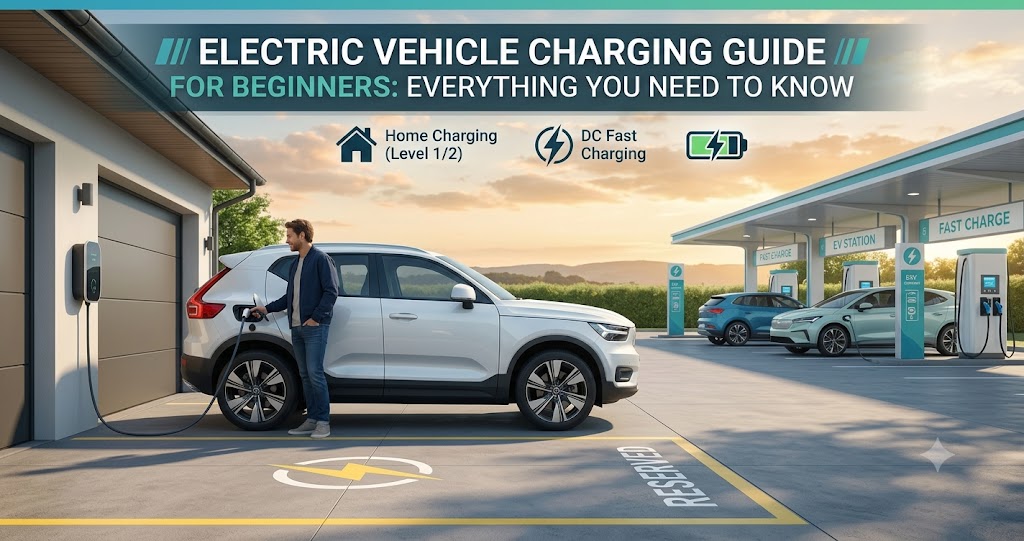
If you’re new to electric vehicles (EVs), understanding charging can seem confusing at first. This electric vehicle charging guide for beginners explains the different charging levels, charging times, costs, and best practices to help you confidently charge your EV at home, work, or public charging stations.
Key Takeaways
- EV charging is simpler than most beginners expect.
- There are three main charging levels: Level 1, Level 2, and DC Fast Charging.
- Home charging is the most convenient option for daily use.
- Public charging stations are ideal for long-distance travel.
- Charging speed depends on your vehicle, battery size, and charger type.
- Proper charging habits can improve battery lifespan.
Why Understanding EV Charging Matters
As electric vehicles become more popular, knowing how charging works is essential. Unlike traditional gasoline vehicles, EVs rely entirely on electricity stored in a battery pack.
Learning the basics of charging helps you:
- Reduce charging costs
- Avoid range anxiety
- Improve battery health
- Plan long trips efficiently
- Maximize convenience
Pro Tip: Most EV owners charge their vehicles overnight at home, similar to charging a smartphone.
Types of Electric Vehicle Charging
Level 1 Charging
Level 1 charging uses a standard household outlet.
| Feature | Level 1 Charging |
| Voltage | 120V |
| Charging Speed | 3–8 km range/hour |
| Installation | No special setup |
| Best For | Overnight charging |
This option is suitable for drivers with short daily commutes.
Level 2 Charging
Level 2 chargers require a dedicated charging unit.
| Feature | Level 2 Charging |
| Voltage | 240V |
| Charging Speed | 20–60 km range/hour |
| Installation | Professional installation |
| Best For | Daily charging |
Most EV owners prefer Level 2 charging because it significantly reduces charging time.
DC Fast Charging
DC Fast Chargers are commonly found at public charging stations.
| Feature | DC Fast Charging |
| Charging Speed | 80% charge in 20–45 minutes |
| Location | Public stations |
| Best For | Road trips |
Expert Insight: Frequent fast charging is convenient but should not be your primary charging method if battery longevity is a priority.
How Long Does It Take to Charge an EV?
Charging time depends on:
- Battery capacity
- Charger power output
- Current battery level
- Vehicle charging limitations
Estimated Charging Times
| Charger Type | Typical Charging Time |
| Level 1 | 20–50 hours |
| Level 2 | 4–10 hours |
| DC Fast Charger | 20–60 minutes |
In practice, most drivers simply plug in overnight and wake up with a full battery.
Home Charging vs Public Charging
Home Charging Benefits
- Maximum convenience
- Lower charging costs
- Overnight charging capability
- Better battery management
Public Charging Benefits
- Ideal for long journeys
- Fast charging availability
- Convenient while traveling
A balanced approach often works best. Use home charging for everyday driving and public chargers when necessary.
Pro Tip: Install your home charger near your regular parking spot to simplify daily charging routines.
Common EV Charging Connectors
Different vehicles may use different charging connectors.
Popular Connector Types
- Type 1 Connector
- Type 2 Connector
- CCS Connector
- CHAdeMO Connector
- Tesla Connector (varies by region)
Before purchasing an EV, verify compatibility with local charging infrastructure.
Best Charging Practices for Battery Health
Battery care plays a major role in long-term EV performance.
Recommended Habits
- Keep battery levels between 20% and 80% for daily use.
- Avoid frequent deep discharges.
- Limit unnecessary fast charging.
- Follow manufacturer charging recommendations.
- Park in shaded areas during extreme heat.
A common bottleneck is assuming the battery must always reach 100%. For everyday driving, partial charging is often better for battery longevity.
Planning Long-Distance EV Travel
Modern EVs make road trips easier than ever.
Before traveling:
- Locate charging stations along your route.
- Check charger availability.
- Allow extra charging time.
- Monitor weather conditions, as temperature can affect range.
- Use EV navigation tools for real-time charging information.
Strategic planning eliminates most charging concerns during long trips.
Frequently Asked Questions
1. Can I charge my EV every night?
Yes. Regular overnight charging is safe and recommended for most electric vehicles.
2. Is home charging cheaper than public charging?
In most cases, home charging costs less than public fast charging stations.
3. Does fast charging damage the battery?
Occasional fast charging is safe, but frequent use may increase battery wear over time.
4. Should I charge my EV to 100% every day?
For daily driving, keeping the battery between 20% and 80% is generally recommended.
5. What happens if my EV battery runs out completely?
The vehicle will stop driving, so it’s important to recharge before reaching a critically low battery level.
Understanding EV charging is one of the most important steps in becoming a confident electric vehicle owner. Once you learn the differences between charging levels, charging times, and battery care practices, the process becomes simple and convenient.
Whether you’re considering your first EV or have recently purchased one, start by setting up a reliable charging routine. The sooner you become familiar with EV charging, the more enjoyable and stress-free your electric driving experience will be.
Ready to Start Your EV Journey?
Explore more electric vehicle guides, battery maintenance tips, and charging strategies to make the most of your EV ownership experience.