Introduction
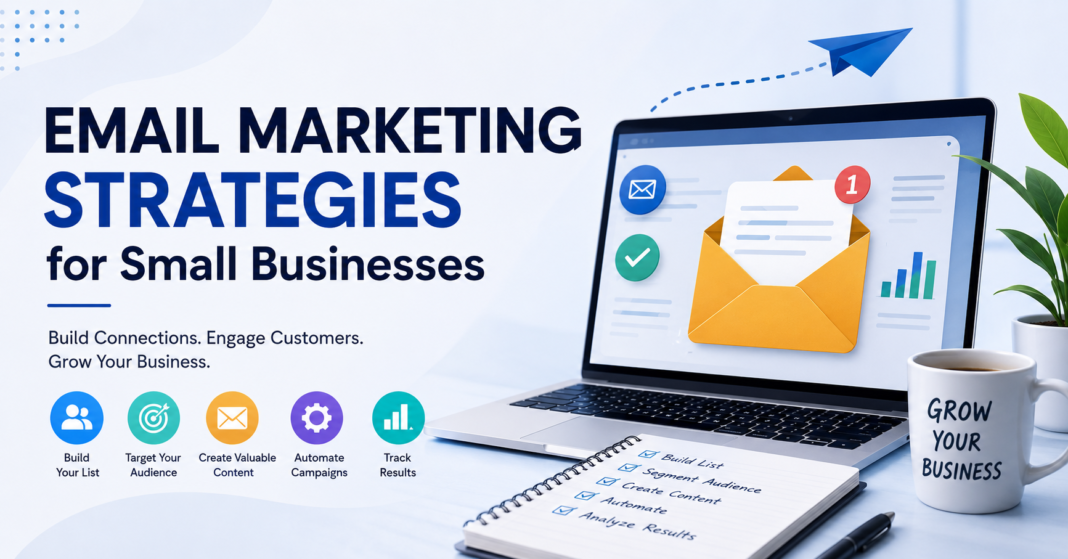
Email marketing remains one of the most effective digital marketing channels for small businesses. While social media algorithms constantly change, email gives you direct access to your audience. With the right approach, small businesses can build stronger customer relationships, increase conversions, and generate consistent revenue.
If you’re looking for proven email marketing strategies for small businesses, this guide will help you create campaigns that engage subscribers and drive measurable results.
Why Email Marketing Matters for Small Businesses
Email marketing offers several advantages:
- Low marketing costs
- High return on investment (ROI)
- Direct communication with customers
- Better customer retention
- Increased sales opportunities
Unlike paid advertising, your email list is an asset you own and control.
Build a Quality Email List
The foundation of successful email marketing starts with a quality subscriber list.
Effective Ways to Grow Your List
- Add signup forms to your website
- Offer free guides or resources
- Create exclusive discounts for subscribers
- Use pop-up forms strategically
- Collect emails during purchases
Pro Tip: Focus on attracting interested subscribers rather than buying email lists, which often lead to poor engagement and spam complaints.
Segment Your Audience
Not all subscribers have the same interests or needs.
Segment your audience based on:
| Segmentation Type | Example |
| Purchase History | New vs. Repeat Customers |
| Location | City or Region |
| Interests | Product Categories |
| Engagement Level | Active vs. Inactive Users |
Segmentation allows you to send more relevant messages, leading to higher open and click rates.
Create Personalized Email Campaigns
Personalization goes beyond using a subscriber’s first name.
Consider personalizing:
- Product recommendations
- Special offers
- Birthday promotions
- Follow-up emails
- Customer journey stages
When deploying personalized campaigns, focus on delivering value rather than simply increasing email frequency.
Expert Insight: Relevant emails often outperform generic newsletters, even when sent less frequently.
Write Compelling Subject Lines
Your subject line determines whether recipients open your email.
Best Practices
- Keep it under 50 characters
- Create curiosity
- Highlight benefits
- Use action-oriented language
- Avoid spam-trigger words
Examples:
- Save 20% on Your Next Order
- New Products Just Arrived
- Your Exclusive Member Offer
A strong subject line can significantly improve campaign performance.
Use Automation to Save Time
Email automation helps small businesses stay connected with customers without constant manual effort.
Essential Automated Email Sequences
| Email Type | Purpose |
| Welcome Series | Introduce New Subscribers |
| Abandoned Cart | Recover Lost Sales |
| Follow-Up Emails | Encourage Repeat Purchases |
| Re-engagement Campaigns | Win Back Inactive Users |
| Thank You Emails | Build Customer Loyalty |
Automation ensures timely communication while reducing workload.
Focus on Valuable Content
People subscribe because they expect value.
Include:
- Helpful tips
- Industry insights
- Product tutorials
- Customer success stories
- Exclusive promotions
A common bottleneck is sending too many sales-focused emails. Balance promotional content with educational information.
Pro Tip: Follow the 80/20 rule—80% valuable content and 20% promotional messages.
Optimize for Mobile Devices
Most emails are opened on smartphones.
Ensure your emails:
- Use responsive designs
- Have short paragraphs
- Feature clear call-to-action buttons
- Load quickly
- Use readable font sizes
A mobile-friendly experience improves engagement and conversion rates.
Track Key Email Marketing Metrics
Monitoring performance helps improve future campaigns.
Important Metrics to Track
- Open Rate
- Click-Through Rate (CTR)
- Conversion Rate
- Unsubscribe Rate
- Bounce Rate
Review these metrics regularly to identify what’s working and what needs improvement.
Common Email Marketing Mistakes to Avoid
Avoid these frequent errors:
- Buying email lists
- Sending irrelevant content
- Ignoring segmentation
- Using misleading subject lines
- Failing to test campaigns
Small improvements can have a major impact on results over time.
Frequently Asked Questions
1. Is email marketing still effective for small businesses?
Yes. Email marketing consistently delivers one of the highest ROIs among digital marketing channels.
2. How often should small businesses send emails?
Most businesses benefit from sending one to four emails per month, depending on audience preferences and industry.
3. What is the best email marketing platform for beginners?
Popular beginner-friendly platforms include Mailchimp, ConvertKit, and Brevo.
4. Why is audience segmentation important?
Segmentation improves relevance, engagement, and conversion rates by delivering targeted content to specific groups.
5. What should I include in a marketing email?
Include valuable content, a clear message, engaging visuals, and a strong call-to-action that encourages readers to take the next step.
Start Growing Your Business with Email Marketing
Implementing these email marketing strategies for small businesses can help you build stronger customer relationships, increase engagement, and drive more sales. Start by growing a quality email list, creating valuable content, and using automation to nurture leads effectively.
The sooner you build a strategic email marketing system, the sooner you’ll create a reliable channel for long-term business growth.